![Text logo reads Simpli [house emoji][heart emoji] Painted. Preferred for a reason. The house and heart emojis replace the word love. Black text on a white background.](https://simplipainted.com/wp-content/uploads/2026/08/cropped-IMG_3593.jpg.webp)

Still using 1920s technology?
Why Budget Cabinet Painters Still Spray a Finish Made for 1920s Cars
Lacquer vs. polyurethane isn’t a close call. Nitrocellulose lacquer was adapted for automobiles a century ago. It’s 2026 — your kitchen deserves a modern coating engineered for steam, spills, cleaners, and daily use.
A 100-year-old idea
Lacquer: A Century-Old Finish in a Modern Kitchen
In 1922, DuPont and General Motors began adapting a nitrocellulose lacquer into a car finish called Duco. According to the Science History Institute, it debuted on Oakland’s 1924 touring cars at the New York Automobile Show in December 1923.
Compared to the slow, multi-step varnishes of the day, it was a breakthrough: fewer steps, far shorter drying time, and lower labor cost. That speed is exactly why nitrocellulose lacquer later spread into furniture and cabinet shops.
But finishing technology didn’t stop in the 1920s. Today’s professional cabinet coatings — like waterborne acrylic cabinet topcoats and other modern cabinet coatings — were engineered specifically for the moisture, chemicals, and wear a kitchen dishes out.
Budget painters don’t keep using lacquer because it’s better for your kitchen. They use it because it’s cheap, easy, and fast for them.

Why Budget Painters Love Lacquer (And Why That Should Concern You)
Lacquer’s popularity with low-bid painters has more to do with their bottom line than your cabinets.
Low Cost
Traditional lacquer is an inexpensive, widely available finish. A cheaper product makes a cheaper bid — not a better cabinet.
Fast & Easy
Woodworking Clarity notes lacquer dries to the touch in about ten minutes and can be recoated in roughly half an hour. More coats per day means more jobs per week.
Low Skill Barrier
Lacquer is forgiving to spray, so almost anyone can apply it. That’s why quality varies so widely from crew to crew.
Modern Professional Coatings Demand More
- Premium, engineered materials that cost more up front
- Specialized spray equipment and technique for a smooth, factory-like finish
- Thorough surface prep with no shortcuts
- Controlled temperature and humidity during application
- Trained, experienced sprayers
The bottom line: Lacquer is built around what’s easiest for the painter. Modern cabinet coatings are built around what lasts for the homeowner.
The timeline
How Lacquer Fell Behind
1922
DuPont & GM Develop Duco
A nitrocellulose lacquer is adapted into a fast-drying automotive finish.
1923
Duco Debuts on the 1924 Oakland
Fast-dry lacquer replaces slow varnish on the assembly line.
Mid-1900s
Lacquer Moves Into Cabinet Shops
Its speed makes it a go-to for furniture and cabinet production.
Today
Pros Have Moved On
Waterborne acrylic cabinet topcoats and other high-performance cabinet coatings set the modern standard.
5 Reasons Lacquer Cabinets Fail in the Kitchen
Whether a painter sprays standard nitrocellulose lacquer or “upgraded” catalyzed lacquer, there are trade-offs. Here’s what finishing experts say.
Problem #1
Moisture Damage & “Milky” White Haze
On WOODWEB, a finishing professional explains that nitro lacquer “does not have the ability to keep prolonged moisture content out, like around a dishwasher or splashing from a sink area.” Another notes the white haze homeowners see is “trapped moisture under the lacquer.”
That same discussion is blunt: plain lacquer “should not be used as a finishing system for kitchen or bathroom cabinetry.”
Problem #2
Weak Against Heat & Chemicals
Woodworking Clarity states that lacquer “offers little protection from heat and chemicals.” OUI Colour Paint adds that lacquer “can be less forgiving” on surfaces exposed to standing water, heat, alcohol, or heavy daily use.
- Steam and heat from cooking and appliances
- Household cleaners and alcohol
- Food and drink spills
- Constant handling of doors and drawers
Problem #3
Catalyzed Lacquer Can Crack
Painters often pitch catalyzed lacquer as the fix. But Popular Woodworking warns that catalyzed finishes “get so hard that they crack if the film build is too thick,” and most manufacturers say to keep total film build under five mils — about three coats.
One heavy-handed coat too many, and the cabinet is set up to crack.
Problem #4
Catalyzed Lacquer Is Hard to Repair
According to Popular Woodworking, catalyzed finishes “are much more difficult to repair invisibly if they should get damaged.”
Chips and dings can become permanent eyesores instead of simple touch-ups.
Problem #5
Recoating Becomes Risky Once It Cures
On WOODWEB, finishers explain that once catalyzed lacquer fully cross-links, fresh coats may not bond properly — which makes future refreshes and repairs unreliable.
The catch-22: standard lacquer doesn’t hold up to kitchen moisture, and the catalyzed version trades that for brittleness and repair headaches.
Lacquer vs. Polyurethane and Modern Acrylics: Why Newer Coatings Win
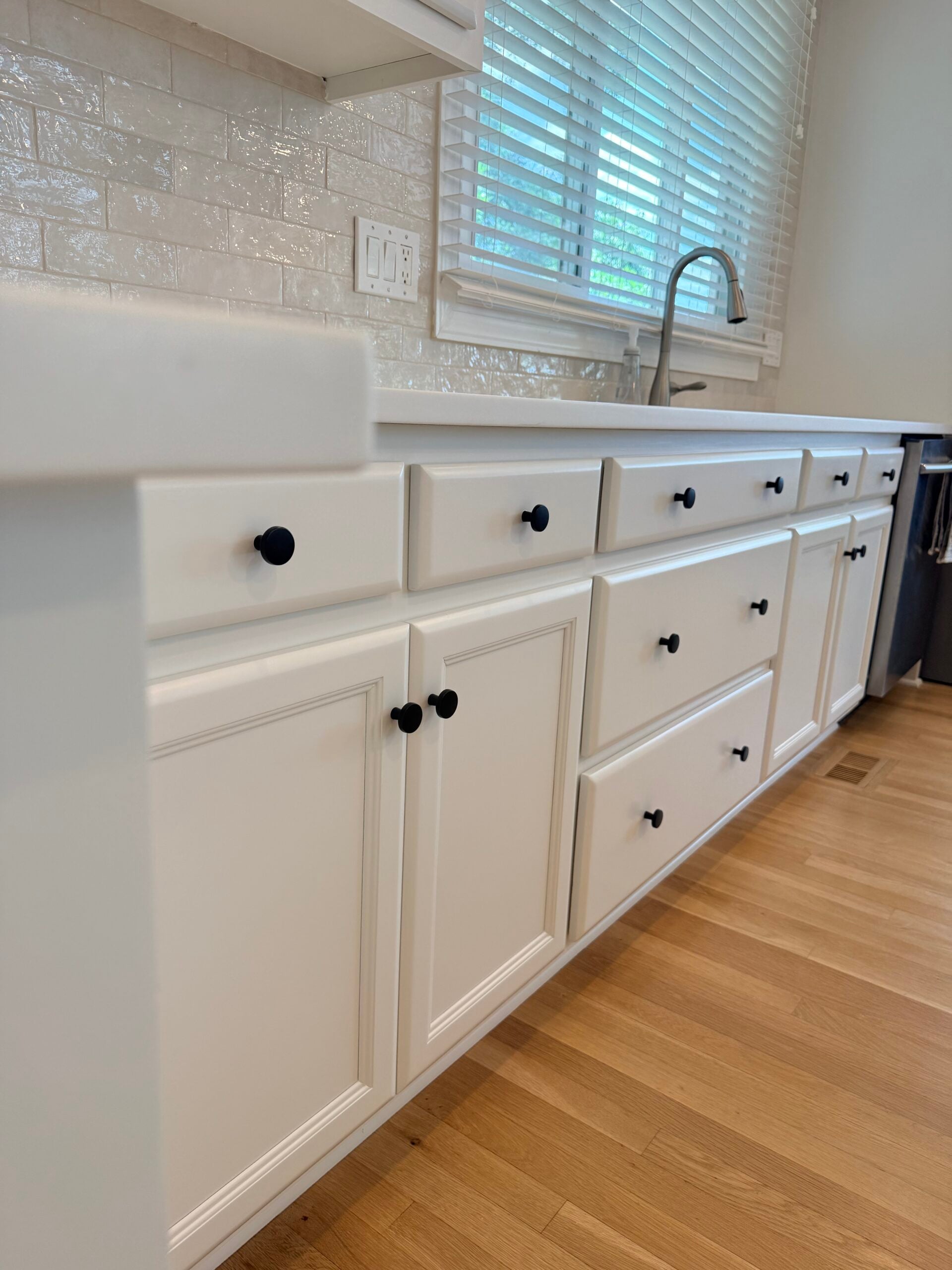
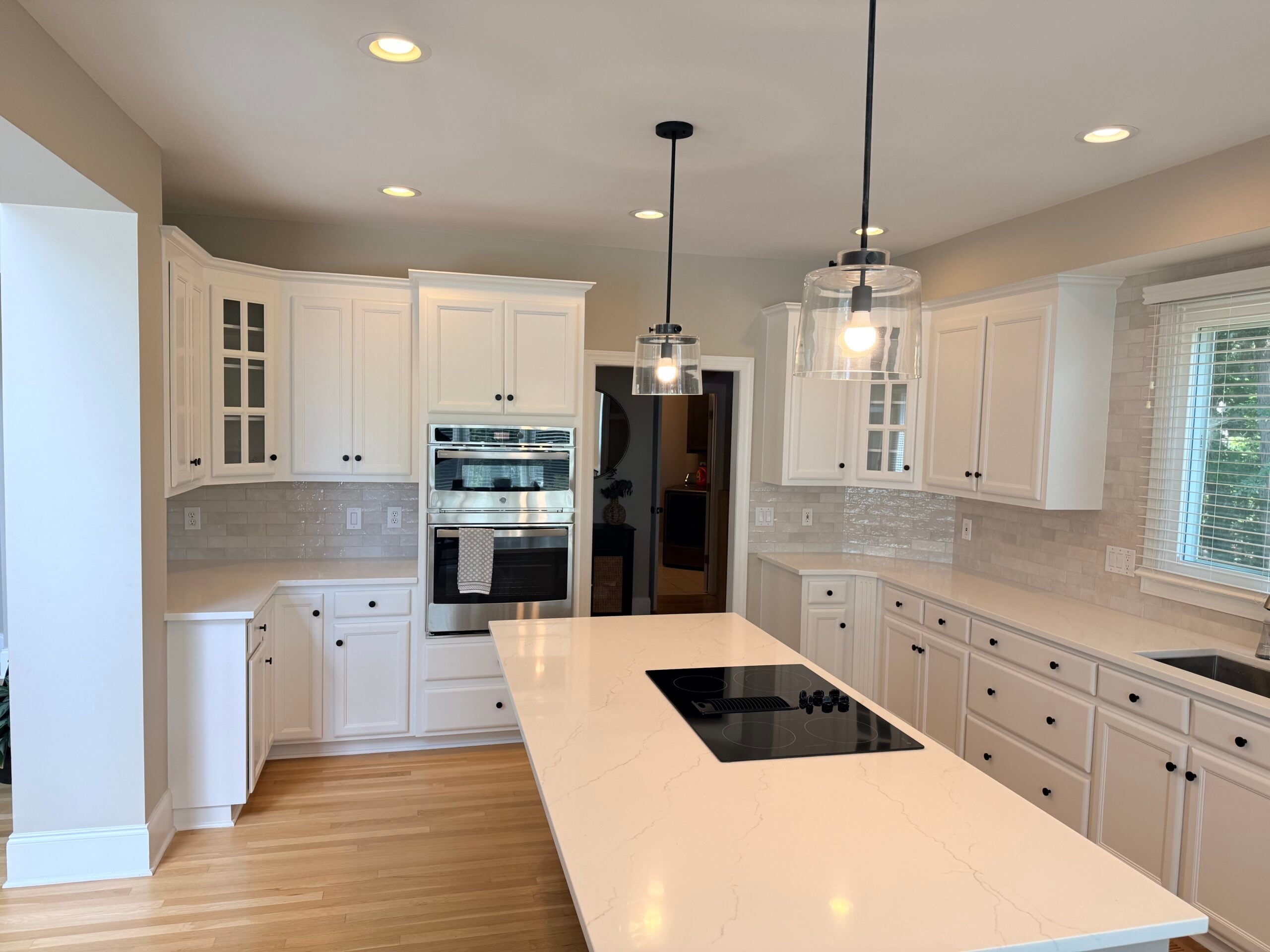
OUI Colour Paint says polyurethane “creates a hard film that resists scuffs, scratches, spills, and repeated cleaning,” with “excellent resistance to abrasion, moisture, household cleaners, and everyday wear.” Woodworking Clarity describes it as scratch-, water-, stain-, and even heat-resistant.
Two kinds of modern coating beat lacquer in a kitchen. The first is polyurethane, including the two-part systems from Italian makers like Renner, Milesi, ILVA, and ICRO, where a hardener is mixed in before spraying and the film chemically cures. The second is the newer single-component waterborne acrylic cabinet coating, which is what Sherwin-Williams Gallery Series is. Gallery Series is not a polyurethane. It needs no hardener and has no pot life, and Sherwin-Williams describes it as delivering the performance of a two-part finish in a single-component product (product data sheet). A properly mixed two-part polyurethane will still edge it on hardness and chemical resistance. What both have in common is that neither one turns yellow, goes brittle, or hazes up with moisture the way lacquer does.
Scratch & Scuff Resistant
Stands up to kids, pets, and busy kitchens.
Moisture Resistant
Built for dishwasher steam and sink splashes.
Cleaner Resistant
Holds up to repeated wiping and household cleaners.
Stain Resistant
Spills wipe away instead of soaking in.
Heat Resistant
Better protection around ovens and appliances.
Thicker Protective Film
A tougher barrier between your cabinets and daily life.
The Coatings We Trust
Our go-to system is Sherwin-Williams Gallery Series, a single-component waterborne acrylic coating built specifically for cabinetry. Italian makers like Renner and Milesi sell the polyurethane systems on the other side of that modern class. None of them are lacquer.
We spray Gallery Series on every job because we know exactly how it behaves, but it is not the only option. If you would rather have a product from Renner, Milesi, ILVA, ICRO, or another professional brand, tell us at the quote stage. As long as we can source it, we can spray it, and the prep, priming, and shop process stay the same.
What Simpli Painted uses
Sherwin-Williams Gallery Series
Gallery Series Waterborne Topcoat is a waterborne acrylic cabinet coating built specifically for kitchen cabinets, not a polyurethane and not a lacquer. It meets Kitchen Cabinet Manufacturers Association (KCMA) requirements and delivers excellent hardness with superior moisture and chemical resistance.
Made in Italy
Renner Italia
An Italian coatings manufacturer based near Bologna, Renner produces professional water-based and solvent-based wood coatings used by finishers worldwide.
Made in Italy • Since 1947
Milesi Wood Coatings
Milesi has specialized in wood coatings since 1947, including high-performance waterborne coatings for cabinetry and furniture.
What Professional Painters Know (That Budget Painters Don’t)
A great cabinet finish isn’t just the product in the can. It’s the process:
- Proper surface prep — cleaning, degreasing, and sanding for maximum adhesion
- The right primer — a solid, compatible base for the topcoat
- Professional-grade coatings — engineered for performance, not price
- Controlled conditions — proper temperature, humidity, and cure time
- Quality control — experienced crews who know when something isn’t right


See the results for yourself: browse our project gallery, read our customer reviews, or check our cabinet painting cost guide.
Before you hire anyone, ask one question: “What coating system will you use on my cabinets?” If the answer is lacquer, keep looking.

Stop Settling for a Finish From the 1920s
Get cabinets that look beautiful and hold up to real life. Schedule a free consultation with Simpli Painted and see the difference a modern coating system makes.
Sources & Further Reading
- Science History Institute: True Blue — DuPont and the Color Revolution
- Wikipedia: Duco
- Popular Woodworking: Catalyzed Finishes
- WOODWEB: When Lacquer Goes Bad
- WOODWEB: Catalyzed Versus Uncatalyzed Lacquers
- OUI Colour Paint: Lacquer vs. Polyurethane Finish
- Woodworking Clarity: Lacquer vs. Polyurethane
- Sherwin-Williams: Gallery Series Waterborne Topcoat
- Renner Italia
- Milesi Wood Coatings
