![Text logo reads Simpli [house emoji][heart emoji] Painted. Preferred for a reason. The house and heart emojis replace the word love. Black text on a white background.](https://simplipainted.com/wp-content/uploads/2026/08/cropped-IMG_3593.jpg.webp)
What a Cabinet Painting Warranty Should Cover
A freshly painted kitchen can look exceptional on day one. The real test comes later, when cabinet doors are opened hundreds of times, drawers rub against frames, steam rises from the dishwasher, and daily cooking leaves its mark. A cabinet painting warranty gives homeowners a clearer picture of how confidently a contractor stands behind the process used to create that finish.

For Charlotte-area homeowners updating sound but dated cabinetry, a warranty should never be the only reason to choose a refinishing company. It is, however, a meaningful indicator of accountability. The right coverage should be supported by meticulous preparation, cabinet-specific materials, and controlled spray finishing – not broad promises that leave the details unclear.
Why a Cabinet Painting Warranty Matters
Cabinets are not painted walls. They are high-touch surfaces exposed to grease, moisture, impacts, cleaning products, and constant movement. A finish can look smooth at installation yet fail prematurely if contaminants were not removed, sanding was skipped, the wrong primer was used, or the coating was applied under poor conditions.
That is why a professional warranty matters most as evidence of the work behind the paint. It signals that the contractor has considered what can happen after the project is complete and has established a process designed to prevent common finish problems.
A homeowner should also recognize the practical limit of any warranty: it cannot turn a compromised cabinet box, water-damaged door, failing hinge, or unsuitable cleaning habit into a perfect surface. Good coverage distinguishes between workmanship-related finish failure and damage caused by conditions outside the painter’s control.
What Cabinet Painting Warranty Coverage Should Include
Every company writes its terms differently, so homeowners should ask for the actual warranty in writing before approving a project. Still, quality cabinet painting warranties commonly focus on failures connected to preparation and coating application.
Peeling, flaking, or loss of adhesion
Peeling is one of the clearest signs that a coating did not bond correctly to the surface beneath it. Cabinet doors often carry years of cooking residue, furniture polish, hand oils, and silicone-based cleaners. Painting over those contaminants can create a finish that looks acceptable initially but releases later.
A workmanship warranty should address peeling, flaking, or adhesion failure that occurs under normal household use. It should also explain how the contractor will evaluate the issue and what repair may involve. Depending on the area and cause, repair could require localized refinishing or refinishing an entire door or drawer front to maintain a consistent appearance.
Chipping beyond normal wear
No painted cabinet finish is indestructible. A sharp impact from a cast-iron pan, a child’s toy, or an aggressively shut door can chip even a premium coating. That type of isolated physical damage is usually not a workmanship issue.
However, widespread chipping at edges, around hardware, or on frequently used doors may point to inadequate prep, insufficient cure time, poor material selection, or a problem with the original coating. A thoughtful warranty explains the difference rather than promising that cabinets will never show wear.
Cracking, bubbling, or unusual finish defects
Cracking, bubbling, wrinkling, or blistering can result from problems in the coating system or application conditions. For example, applying finish over an incompatible surface or coating too heavily can create defects that become more visible as the finish cures.
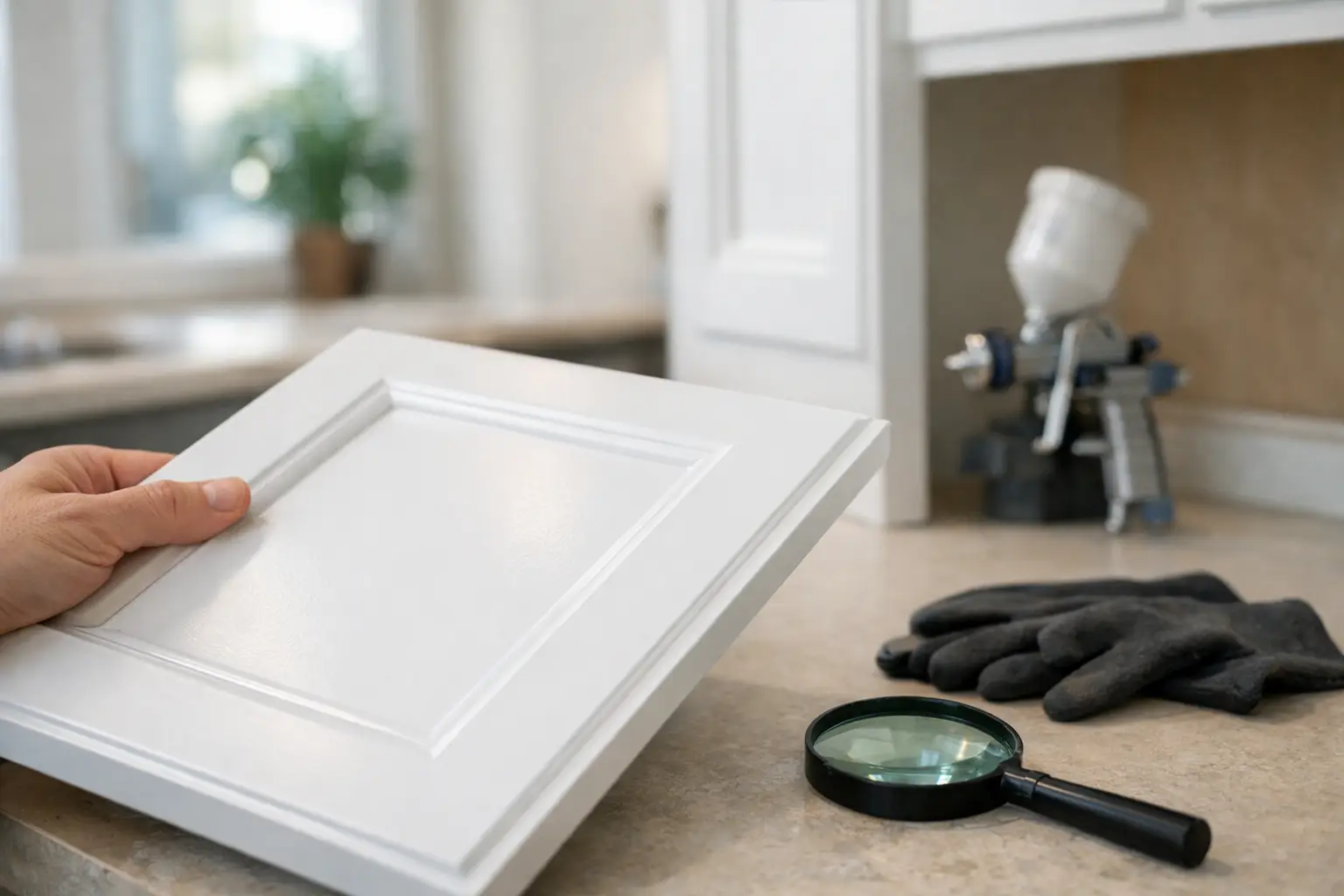
This is where cabinet specialization matters. Proper refinishing is a sequence: cleaning and degreasing, sanding, repairing minor surface imperfections, priming where needed, and applying the finish with consistent technique. Doors and drawer fronts are best finished in a controlled environment, where dust, temperature, and application conditions can be managed more carefully than in an open kitchen.
Yellowing or discoloration caused by the coating system
Homeowners selecting white or light-colored cabinets understandably want that color to stay clean and refined. Some paints and clear coats are more likely to yellow over time, particularly in areas with heat or limited natural light.
If yellowing is related to an inappropriate product or coating failure, it may be a reasonable warranty concern. Yet discoloration caused by smoke, cooking residue, sun exposure, or harsh chemicals may not be covered. The key is to ask what products are being used and how the contractor evaluates color-change concerns after installation.
What a Warranty Usually Does Not Cover
Clear exclusions are not a red flag. In fact, they are often a sign that a company is setting realistic expectations rather than making a promise it cannot honor. A credible warranty should be specific about what falls outside normal workmanship coverage.
Common exclusions may include water damage from leaks, swelling or separation in particleboard or MDF, damage caused by malfunctioning appliances, structural movement, hardware failure, impact damage, and cleaning with abrasive pads or strong solvents. Existing cabinet defects can also affect what is possible. Veneer that is already lifting, doors that are badly warped, or cabinets with extensive grease saturation may require repair or may not be suitable candidates for refinishing without additional work.
Natural wear at contact points deserves an honest conversation as well. Cabinet doors and drawers touch one another in small areas. Even with careful adjustment and a durable finish, these high-contact locations may eventually show minor wear. A specialist should inspect alignment and make appropriate adjustments, but a warranty should not imply that mechanical friction will never affect a painted surface.
Questions to Ask Before You Sign
The strongest warranty is one you understand before the work begins. Rather than simply asking, “How long is your warranty?” ask what it covers, what it excludes, and how a claim is handled.
Ask whether the warranty covers labor as well as materials. Confirm whether it applies to doors, drawer fronts, cabinet boxes, and panels, since these components may be finished differently. Find out whether repairs are handled on site or whether doors are removed for refinishing. It is also worth asking whether matching is guaranteed if a repair is needed after the finish has aged in the home.
Most importantly, ask what preparation steps occur before paint is applied. A contractor should be able to clearly describe the cleaning and degreasing process, sanding approach, primer selection, repair work, masking and protection, and spray-finishing method. A long warranty without a disciplined process is far less valuable than well-defined coverage supported by cabinet-specific workmanship.
The Process Behind Durable Coverage
A quality finish starts well before color is sprayed. Kitchen cabinets must be thoroughly cleaned and degreased to remove the invisible residue that interferes with adhesion. Surfaces are then sanded to create the appropriate profile for primer and finish coats. Imperfections can be addressed before they become more noticeable under a smooth painted finish.
From there, the right primer creates a stable foundation, especially on wood species, previously coated surfaces, or areas with stains and tannin concerns. Doors and drawer fronts benefit from controlled spraying because it produces a more even, factory-finish appearance than a rushed brush-and-roll approach. Cabinet boxes are carefully protected, prepared, and finished in the home with attention to cleanliness and detail.
This process does take more planning than general house painting. It also helps explain why professional cabinet refinishing can deliver a high-end transformation at a fraction of cabinet replacement while preserving cabinetry that is still structurally sound.
How to Protect Your Refinished Cabinets
A warranty covers qualifying workmanship concerns, but everyday care helps preserve the finish for years. Use a soft cloth with a mild, non-abrasive cleaner, then wipe moisture away rather than allowing it to sit along door edges or seams. Avoid scouring pads, solvent-heavy cleaners, harsh degreasers, and products that leave a waxy residue.
Address plumbing leaks quickly, especially beneath sinks and near dishwashers. Use cabinet hardware to reduce repeated contact with painted door faces, and avoid hanging damp towels over doors. If doors begin rubbing or hinges loosen, have them adjusted before friction damages the finish.
A Warranty Should Reflect Confidence, Not Replace It
When comparing cabinet painters in Charlotte, Lake Norman, Cornelius, Matthews, Waxhaw, or South Charlotte, look beyond the warranty length printed on an estimate. The better question is whether the company has the specialized preparation standards and finishing discipline needed to make that warranty meaningful.
At Simpli Painted, the goal is not simply to change a cabinet color. It is to create a smooth, durable, factory-quality finish that makes an existing kitchen or bathroom feel deliberately renewed. Review the warranty carefully, ask direct questions, and choose the professional whose process gives you confidence every time you reach for a cabinet door.
Thinking about your own cabinets?
Simpli Painted refinishes existing cabinets in the Carolinas and coastal Georgia. Doors and drawer fronts are sprayed in our shop, the boxes are finished in place, and every job carries a 2-year warranty against peeling, blistering and yellowing. 4,000+ kitchens, backed by five-star Google reviews.
Send 3–4 photos of your kitchen and we’ll quote it.