![Text logo reads Simpli [house emoji][heart emoji] Painted. Preferred for a reason. The house and heart emojis replace the word love. Black text on a white background.](https://simplipainted.com/wp-content/uploads/2026/08/cropped-IMG_3593.jpg.webp)
Paint or Replace Kitchen Cabinets? How to Decide (Cost, Condition, Timeline)
A kitchen can feel dated long before it stops working. Honey-oak doors, worn clear coats, heavy espresso finishes, and tired vanity colors can make an otherwise well-built room feel out of step with the rest of the home. For homeowners deciding whether to paint or replace kitchen cabinets, the most useful question is not simply, “Which costs less?” It is, “What condition are my cabinets in, and what result do I want from this investment?”

Replacement is sometimes the right call. But when cabinet boxes are structurally sound and the layout still serves the household well, professional refinishing can create a dramatic, high-end transformation without the expense, material waste, and disruption of a full cabinet tear-out.
Paint or Replace Kitchen Cabinets? Start With the Structure
Cabinet refinishing is a smart option when the existing cabinetry is solid, functional, and properly installed. Many homes in Charlotte, Mooresville, Waxhaw, and Fort Mill have kitchens with quality wood cabinet boxes that were built to last, even if their door style or finish now feels outdated.
A professional assessment should look beyond surface appearance. Are the cabinet boxes level and securely attached? Are doors and drawer fronts in good condition? Do drawers operate smoothly? Is there water damage around the sink, dishwasher, or bathroom vanity? If the answer is largely yes, refinishing may preserve the strongest part of the original investment while delivering the visual change you want.
Replacement becomes more compelling when cabinets have extensive swelling, delamination, broken frames, severe water damage, failing drawer systems, or a layout that no longer works. If you need to relocate appliances, remove walls, add substantial storage, or change the footprint of the kitchen, new cabinetry may be necessary to support the renovation.
The distinction matters because fresh paint cannot correct structural failure. It can, however, make well-made cabinets look entirely new.
What Professional Cabinet Painting Actually Changes
Cabinet refinishing is not the same as applying wall paint to cabinet doors. Cabinetry is a high-touch surface exposed to cooking residue, moisture, fingerprints, cleaning products, and repeated impact from daily use. A lasting finish depends on meticulous preparation and the correct application process.
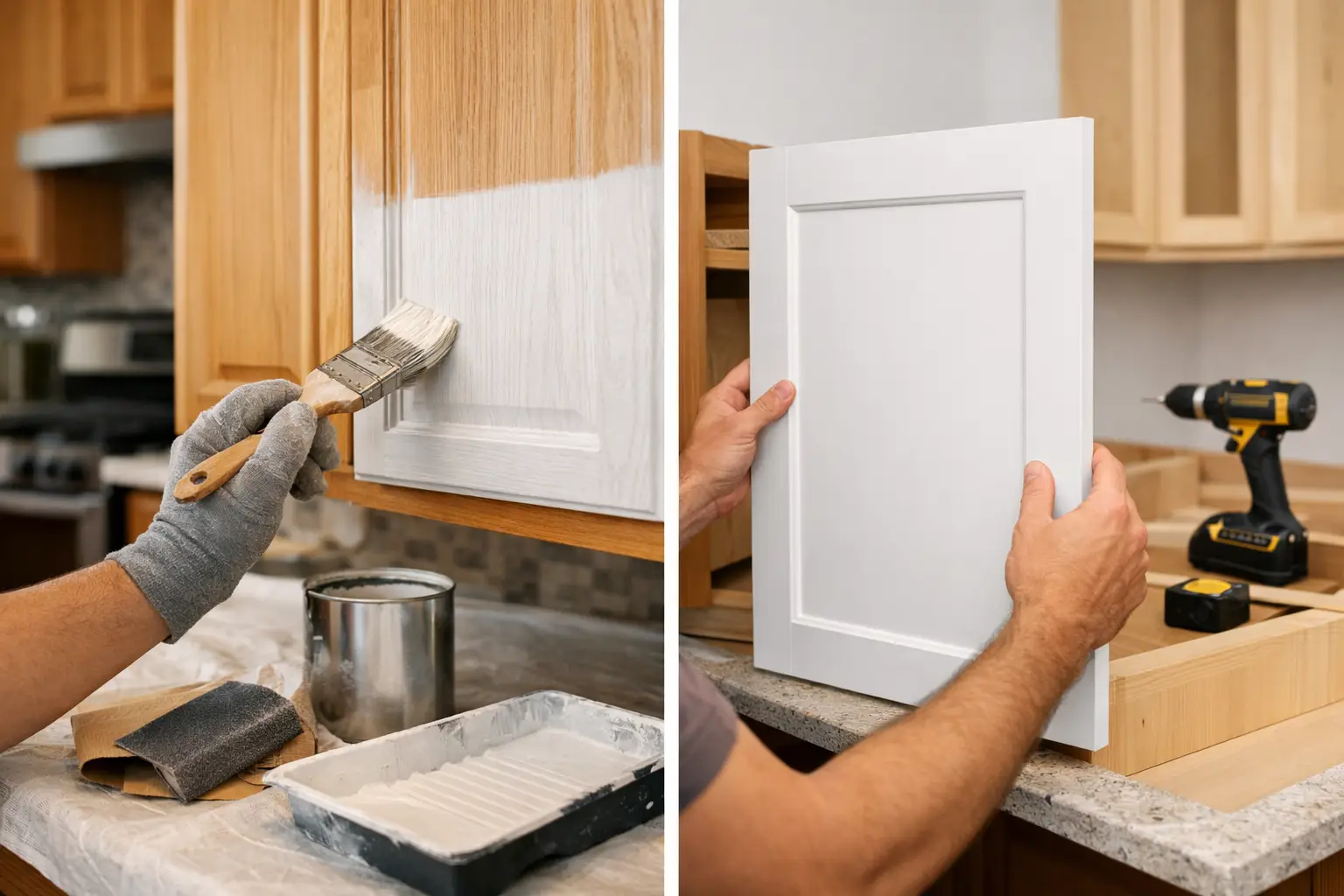
The work begins with cleaning and degreasing to remove oils, residue, and contaminants that can interfere with adhesion. Surfaces are then sanded and prepared to create the right foundation for primer. Any appropriate repairs, filling, and caulking are completed before the finishing system is applied.
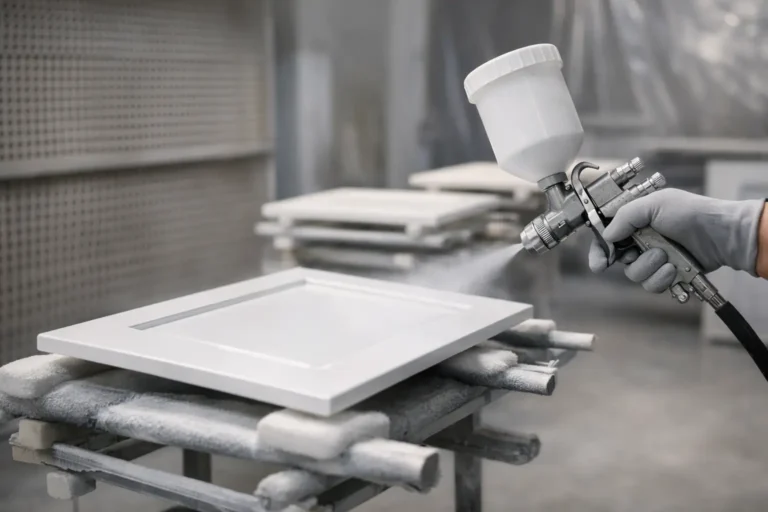
Doors and drawer fronts are typically removed and sprayed in a controlled environment. This approach helps create the smooth, even appearance homeowners associate with a factory-finish rather than visible brush marks or inconsistent roller texture. Cabinet frames are carefully protected and finished on site, with attention to surrounding floors, counters, appliances, and hardware.
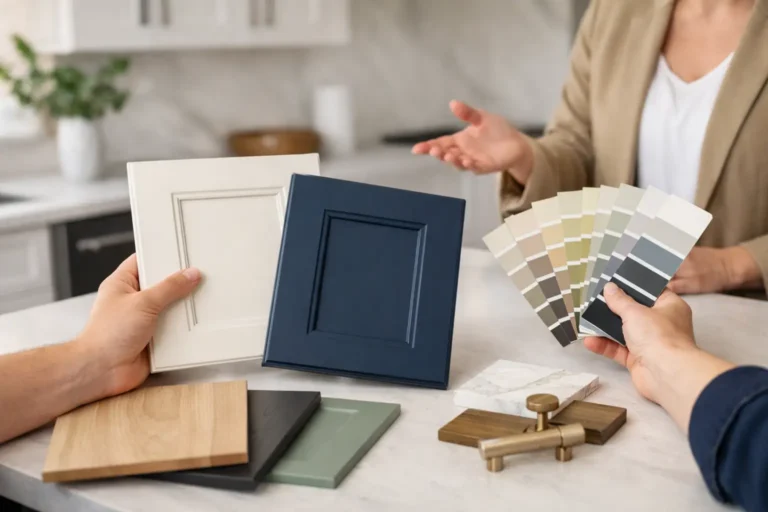
That process allows for a meaningful color transformation. A dated wood tone can become a refined warm white, a soft greige, a deep navy island, or a contemporary neutral that better complements countertops, backsplash tile, flooring, and lighting. Bathroom vanities can receive the same level of attention, often making a smaller space feel cleaner and more current without a complete remodel.
The Cost Difference Is Bigger Than the Cabinet Quote
New cabinets involve more than selecting and ordering boxes, doors, and hardware. A replacement project often includes demolition, disposal, possible flooring or drywall repairs, countertop removal and reinstallation, plumbing and electrical adjustments, backsplash work, and extended time without a functioning kitchen.
Those related costs can quickly change the scope of the project. In Charlotte, installed cabinet replacement commonly runs $15,000 to $35,000 or more, while a professional refinish of the same kitchen typically falls between $3,000 and $8,000. Even when homeowners select mid-range replacement cabinets, installation and finish work may push the overall investment far beyond the original cabinet estimate.
Refinishing usually avoids many of those expenses because the cabinet boxes remain in place. Countertops, plumbing, and much of the kitchen stay intact. The project is still detailed work, but it is generally less invasive than a full renovation and produces far less construction waste.
That does not mean refinishing is the lowest-cost option in every circumstance. Quality materials, careful preparation, controlled spraying, and experienced cabinet specialists all matter. A professional finish is an investment in durability and appearance, not a shortcut. Still, for sound cabinetry, refinishing often delivers one of the strongest visual returns available in a kitchen or bath update.
Consider How Much You Want to Change
Replacement gives homeowners the freedom to change cabinet configuration, door style, storage features, and dimensions. If your kitchen lacks drawers, pantry space, pull-out organization, or adequate room for modern appliances, changing the cabinet system may solve practical problems that paint cannot.
Refinishing is ideal when the layout is already working. Perhaps the cabinets have enough storage, the countertops are in good shape, and the room simply needs a more current color and finish. In that case, preserving the existing structure can keep the project focused on the change people will notice first: the cabinetry’s appearance.
Door style is worth considering here. Raised-panel, recessed-panel, shaker, slab, and traditional profiles can all be refinished. Some styles feel more timeless than others, but color, hardware, lighting, and surrounding finishes can dramatically shift the look of even a familiar door profile. A careful design decision may make replacement unnecessary.
Durability Depends on the Process, Not Just the Product
Homeowners often hear that painted cabinets chip easily. The concern is understandable, especially if they have seen a DIY project or a general painting job fail around handles, drawer edges, or frequently used doors.
The issue is rarely color alone. Adhesion and durability are built through surface preparation, appropriate primers and coatings, correct application, and proper curing. Grease left behind on cabinet doors, gloss that was not properly prepared, or coatings brushed on too heavily can all lead to disappointing results.
A cabinet-focused refinishing process treats every stage as part of the finish system. Cleaning supports adhesion. Sanding creates a prepared surface. Primer establishes a stable base. Controlled spraying creates a consistent, smooth coating. Careful reinstallation and cure time help protect the investment before the kitchen returns to normal use.
Even a factory-quality finish is not indestructible. Cabinets should be cleaned with gentle products, protected from prolonged water exposure, and treated with reasonable care. But professionally refinished cabinets are designed for real daily use, not just a reveal-day photograph.
Timing and Household Disruption Matter
A cabinet replacement project can affect the rhythm of a home for weeks or longer, particularly if countertops, flooring, plumbing, or electrical work are involved. For families who cook often, work from home, or simply want to avoid a major construction zone, the disruption can be a deciding factor.
Refinishing still requires planning. Cabinet contents need to be removed, work areas must be protected, and the kitchen will not operate exactly as usual during the project. Yet the cabinet boxes remain in place, and the overall scope is usually more contained than demolition and reconstruction.
For many homeowners, this balance is the appeal: a highly visible transformation without turning a cosmetic update into a full-scale renovation.
When Replacing Cabinets Is Worth It
There are situations where replacement is the better long-term decision. Choose new cabinets when the existing boxes are damaged beyond practical repair, the kitchen layout is inefficient, the cabinet construction is poor, or you are already undertaking a major remodel that requires changing the room’s footprint.
Replacement may also make sense if you have very limited storage and need deeper drawers, a larger pantry, custom appliance integration, or accessibility improvements. Refinishing honors what is already there; it does not create new square footage or change cabinet dimensions.
The right choice is not about treating replacement as automatically better or refinishing as automatically cheaper. It is about matching the solution to the condition of the cabinetry and the goals of the home.
Painting Cabinets vs Replacing: The Short Version
- Paint when the boxes are solid, the layout works, and the problem is color, wear, or a dated finish. Full kitchen: $3,000 to $8,000, 3 to 5 business days.
- Reface when you want a different door style but the boxes are fine. Costs more than painting; see cabinet painting vs refacing.
- Replace when boxes are water-damaged or swelling, or the layout itself has to change. Expect $15,000 to $35,000 or more installed in Charlotte, plus weeks without a kitchen.
A Better Way to Decide
Before committing to a full tear-out, examine the cabinet boxes, think honestly about how the kitchen functions, and identify what is actually bothering you. If the frustration is primarily color, sheen, visible wear, or an outdated wood finish, professional refinishing deserves serious consideration. If the frustration is storage, layout, damage, or construction quality, replacement may offer more value.
A specialist should be able to explain that difference clearly, not steer every homeowner toward the same service. At Simpli Painted, the goal is to help homeowners preserve quality cabinetry when it makes sense, then transform it through disciplined preparation and a durable, furniture-quality sprayed finish.
Your cabinets do not need to be brand-new to make the room feel new. If the structure is worth keeping, a carefully refinished finish can give your kitchen or bathroom the polished update it has been waiting for.
Should I Paint My Kitchen Cabinets or Replace Them? Quick Answers
Is it worth painting old kitchen cabinets?
If the boxes and doors are structurally sound, yes. Painting keeps the layout and countertop in place and costs a fraction of replacement. If the particleboard is swelling or the doors are delaminating, the money is better spent on replacement.
How much cheaper is painting than replacing cabinets?
In Charlotte, installed replacement commonly runs $15,000 to $35,000 or more. Professional painting of the same kitchen runs $3,000 to $8,000.
Do painted cabinets look cheap?
Not when the doors are sprayed off-site in a shop and the prep is done properly. The finish is smooth, with no brush marks, and it is what most homeowners mean when they picture “new” cabinets. Simpli Painted backs every project with a 2-year warranty covering peeling, blistering, and yellowing.
Thinking about your own cabinets?
Simpli Painted refinishes existing cabinets in the Carolinas and coastal Georgia. Doors and drawer fronts are sprayed in our shop, the boxes are finished in place, and every job carries a 2-year warranty against peeling, blistering and yellowing. 4,000+ kitchens, backed by five-star Google reviews.
Send 3–4 photos of your kitchen and we’ll quote it.